Showing posts with label Comet. Show all posts

Sunday, April 14, 2024

Comet 12/P Pons-Brooks

Comet 12/P Pons-Brooks low on the horizon.
07 Apr 2024 ~18:01 UT, Kyiv [21:01 local time].
Canon EOS 600D, lens f=50mm.
Stack of 20 frames (3.2 sec each)


Friday, January 26, 2018

Comets in January 2018

Two relatively bright comets captured in January 2018.

Place: Kyiv (Osokorky district)
Equipment: Canon EOS 600D + Sky Watcher 10575 OTAW / EQ5 motorized
Processing: IRIS, FITStacker, Fitswork4, RawTherapee

Comet C/2017 T1 (Heinze)
43x30s
2018-01-08 16:09-17:09 UT. Comet position in the frame with stars corresponds to 16:09 UT.
FOV = 40x40 arcmin, North is up.
Processing: IRIS, FITStacker, Fitswork4, RawTherapee


Comet C/2016 R2 (PANSTARRS)
68x30s ISO 1600
2018-01-10 19:49 UT (mid of series)
FOV = 40x25 arcmin, North is up
The blue color of the coma caused by ionized carbon monoxide CO+. Last time a comet with such a high content of CO was observed in 1962.

Tuesday, June 13, 2017

Comet C/2015 V2 (2)

C/2015 V2 (Johnson)

Time: 2017-06-09 23:53 .. 2017-06-10 01:17 UT+3
Kyiv
Moon was full (99.9%) so the background was severely highlighted.
Setup: Sky Watcher 15075 OTAW on EQ5 with motor drives (no guiding); Canon EOS 600D
89 light frames 30s each; 21 offsets; 21 darks; 18 flats.
Processing: IRIS (calibration, stacking by the comet); postprocessing: FITStacker, FITSwork4, RawTherapee
North: up, West: to the right.

Animation (the same 89 frames; calibration and alignment: DeepSkyStacker; postprocessing: RawTherapee, FSViewer, VirtualDub)
2017-06-09 23:53 .. 2017-06-10 01:17 UT+3
(1h24min)
45'x45'

Friday, May 19, 2017

Comet C/2015 V2

Comet C/2015 V2
17-05-2017 22:50-23:54 (UT+3)
Kyiv

Setup: Canon EOS 600D + SkyWatcher 15075 OTAW / EQ5 motorized (no guiding).
Processing: Deep Sky Stacker, FITStacker, RawTherapee. 78x30s (19 darks, 19 biases, 10 flats).

Image size: 50x50 arcmin


Orbit diagram (calsky.com)


Wednesday, April 12, 2017

Comet 41P (TGK) Remastered

Images of a comet 41P in my previous post were processed with DeepSkyStacker. It is a very good program to get a quick-and-dirty result of an astrosession. Hovewer, I always got a better output with another free astrosoftware: IRIS. I've never tried to process comet's images yet with IRIS so it is my first attempt to use the special comet-tracking functionality of it.

I reprocessed the same set of frames as in my previous post: 50 frames x 30s, taken at ISO 800 using Canon EOS 600D attached to SkyWatcher 15075 Newtonian on top of motorized EQ5 mount (no guiding). I used 19 dark and 19 offset frames for calibration.

The frames were captured between 23:23 and 23:54 local Kyiv time (UT+3) on 2 Apr 2017.

I should say that IRIS gave a less noisy picture; comet's coma is seen better. In general, the image looks "softer" and "more natural".

A size of the cropped image is 45x45 arcminutes.


Monday, April 10, 2017

Comet 41P Tuttle-Giacobini-Kresak

Comet 41P (TGK) 2 Apr 2017@23:23-23:54 (UT+3) Kyiv

Setup: Canon EOS 600D + SW 15075 OTAW Newtonian on EQ5 with motor drives (no guiding)

50 frames x 30s; ISO 800 (19 darks, 19 offsets)
Processing: DSS + FITStaker + RawTherapee.
The angular size of the resulting cropped picture is 0.75x0.75 degrees; resize 25%.

I could not distinguish the comet by eye trough 28mm eyepiece. Probably it was because of poor transparency of the atmosphere that night. At the beginning I even saw iridescent corona around the Moon, then it disappeared.

The night was very warm (for the season here); the temperature gradually reduced from 16*C to 11*C; calm.
The Big Dipper was near zenith...

It was my first attempt to picture non-planetary object through my new Newtonian. 30-s exposures are good even without guiding.
I could see the comet shift between frames even for such a small interval (33 s from frame to frame)!

The first picture is stacked "by a comet"; the second one -- "by stars". You can see the shift of the comet during ~30min (size of the pictures is 0.75x0.75 degrees -- 1.5 of the visible diameter of the Moon).


An animation (23:23-23:54 (UT+3)); frame size 15'x15':


Tuesday, February 28, 2017

Comet 45P Honda-Mrkos-Pajdusakova (3a)

Eventually I managed to stack frames by the comet (see link).
Two stacking modes were used: "average" (right image) and "sigma-clipping" to reduce stars brightness. Comet's tail is clearly seen.
Size of each image: 3x3 degrees.
2015-02-25; 23:04-23:55(UT+2)

An animation of a proper motion of the comet.
2015-02-25; 23:07-23:52(UT+2)

Sunday, February 26, 2017

Comet 45P Honda-Mrkos-Pajdusakova (3)

Last night: 2017-02-25 23:05-23:55(UT+2)

Kyiv, Osokorky

Setup: Canon EOS 600D with Jupiter 37А lens [135mm] @f/5 on EQ-5 motorized mount.
42x60s frames.

Processing: DSS+FITStacker+RawTherapee.

Because the comet was too dim, I could not make alignment by the comet so alignment by stars was used. This caused distortion of the comet visible nucleus.

Crop 3x3 degrees

Wednesday, January 4, 2017

Comet 45P Honda-Mrkos-Pajdusakova (2)

The next chance to catch the comet occurred on 2nd of January. Despite a weather forecast, the sky was clear.

During the session, the comet was very close to the horizon (~8 degrees).

I used Canon EOS 600D + EF 50mm f/1.8 @f/2.5 on tripod (through open window), ISO=400.

Here is a result of stacking of 77 frames (3.2s each) in Deep Sky Stacker (19 darks and 19 offsets were used for calibration) with subsequent processing in FITStacker and RawTherapee.

A size of the visible field is 4x4 degrees.

The comet is in the center like a green star. A faint star near the comet to the upper-left has a visible magnitude 9.6m.

Date/Time: 2017-01-02 17:27-17:41 (UT+2)
Place: Kyiv


Location (by nova.astrometry.net):

Friday, December 30, 2016

Comet 45P Honda-Mrkos-Pajdusakova

Last evening I caught a comet 45P (Honda-Mrkos-Pajdusakova) near the horizon (altitude <10 degrees).
It seems that comet's magnitude is about 7.5m.


Date/Time: 2016-12-30 ~17:23(UT+2)
Place: Kyiv
Crop 5x5 degrees
Canon EOS 600D + EF 50mm F/1.8 @2.5; 10 frames by 2s, ISO=800; Processed in DSS[20 offsets, 20 darks] + FITSwork4

Annotated picture (by nova.astrometry.net):

Monday, May 2, 2016

Comet 252P/LINEAR: continued

The comet is substantially dimmer than it was in the beginning of April. Nevertheless, it is much brighter than expected (~18m by http://theskylive.com/comets?s=252p).

2016-05-01 23:36-23:44 (UT+3)
Kyiv (Osokorky)

The comet is near the center, a bright star to the left is Alpha Ophiuchi.
An open cluster IC 4665 is visible near the bottom edge, to the left of the center, close to Beta Ophiuchi.
Image size is 15 x 15 deg (by nova.astrometry.net).
Actually, we only see an inner part of comet's coma. The comet itself is quite diffuse, outer parts of coma are too faint to be visible in the image taken in the light-polluted area with short exposures.
Canon EOS 600D + EF 50mm f/1.8 II; ISO3200; F/2.8; 73x3s.
Processing: DSS; FITStacker; RawTherapee; NeatImage; FSViewer.

Tuesday, April 12, 2016

Comet 252P/LINEAR #2

The comet this morning just before dawn (last frames were actually captured at twilight) is in front of Ophiuchus.
Place: Kyïv (Osokorky)
Time: 2016-04-12 04:55-04:59(UT+2).
Equipment: Canon 600D + EF 50mm f/1.8 on tripod; 50x3,2s; f/2.5; ISO=3200.
Processing: DSS, FITStacker, RawTherapee, FSViewer.
Size (by nova.astrometry.net) is 16.5 x 11 deg.

Here is zoomed part of the image (2x2 degree)

Saturday, April 9, 2016

Comet 252P/LINEAR (remastered)

Image of a comet 252P/LINEAR captured on 5 Apr remastered.
150 frames (3.2s each) were processed in DSS using bigger region (resulted image size is 14.8x8.34 degrees). Gradient background was removed using FITStacker, final processing was made using FSViewer, NeatImage, and RawTherapee.
Except the comet, several deep sky objects are visible in the image: globular clusters M14 (to the upper left-left of the comet), M10 (in the upper-right corner of the picture), and NGC 6366 (dim spot to the right of the comet). According to nova.astrometry.net, a size of the picture is 14.8 x 8.34 deg.
*** Image updated on 2016-04-15: contrast enchanced ***

Tuesday, April 5, 2016

Comet 252P/LINEAR

Comet 252P/LINEAR last night from Kyiv (Osokorky). While sky was clear, substantial atmospheric  haze dims stars. Comet is quite visually bright while its predicted magnitude is low (expected ~14m only; last visual observations give brightness ~6m [cometbase.net]). Fuzzy orange "star" to the upper-left of the comet is globular cluster M14.
The comet is periodic (orbital period 5.33 years). This is near-Earth object, it passes quite close both Earth and Jupiter (Earth-Jupiter family comet). In the past, it probably was Jupiters Troyan.


Time: 2016-04-05 (4:24-4:36 UT+3).
Angular size of the image is 4x4 degree (by nova.astrometry.net).
Canon EOS 600D + EF 50mm f/1.8 II on tripod.
150 frames by 3.2s; f/2.5; ISO=3200

The image was made in two steps: initial 150 frames (3.2s) where groupped by 10 and stacked in DSS, then resulted 15 frames where stacked again with alignment by the comet.
To be honest, result with alignment by the comet differs a little from result made using alignment by stars.
Resulted image was treated with FITStacher (background subtraction and gamma-correction) and then postprocessed in RawTherapee.

Tuesday, March 29, 2016

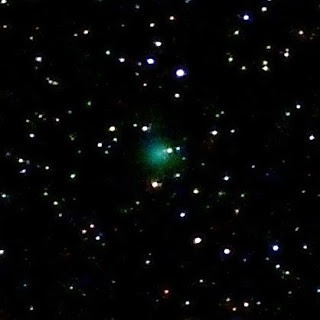
C/2014 S2 PANSTARRS in Draco

2016-03-26 ~19:42-19:57(UT+2); Kyiv
Image angular size: 5x5 degrees (by nova.astrometry.net).
Comet is in the center of an image: small green spot.
According to cometbase.net, apparent magnitude of the comet was about 9.7m


Canon EOS 600D + EF 50mm f/1.8 II on tripod
105x3.2s; f/2.5; ISO=800
DSS, FITStacker, RawTherapee.

Tuesday, February 16, 2016

Evolution of Comet C/2013 US10 (Catalina)

Here is a compilation of my key observations of a comet C/2013 US10 (Catalina). Pictures were taken on 8 Dec 2015; 29 Dec 2015 and 6 Feb 2015 (left to right): I tried to catch clear sky (this winter is extremely cloudy). Place: Kyiv (Osokorky district).

All images are on the same scale, a size of each picture is 2x2 arc degree (approximately four angular diameters of the Moon).

Black-and-white version:

Initial color version:

Two tails of the comet have different nature: straight upper tail (in the first and the second images) is gas ion tail, it points to a direction opposite to the Sun (ions are pushed back by solar wind and light pressure); the other curved tail is of dust, it is more affected by Sun's gravitation and is left behind in the comet's orbit.

The distance between the comet and the Sun increases from the first to the third picture (while distance between the comet and Earth for the second picture is less substantially than for the first and somewhat bigger than for the third): the comet's activity decreases, only the dust tail is revealed in the last image.

To make the photos, I used Canon EOS 600D with EF 50mm F/1.8 II lens on fixed tripod. Images were captured and processed in different conditions: there were 100x3s, 260x4s, and 210x12s individual frames averaged for the first, the second, and the third images respectively.

While processing, stacking by comet position was used. Stars in the first picture are affected by Earth's rotation (or, partially, optical distortion of the lens) while on the next two pictures star trails arose because of comet's own movement (remember that I stacked images using comet's position as a reference).
Finally, I made an animation from a set of frames captured during the third session. Here is comet's own movement during approximately an hour (57 min).

1x1 arc degree


Saturday, February 13, 2016

C/2013 US10 (Catalina) in Camelopardalis -- Remastered

An image of the comet in a post on 7-Feb was substantially distorted because the comet was moving on the star background during registration. An image beneath is "remastered". I took all frames taken during the session (210 individual frames having exposure of 12.34s each) and made averaging by 10 frames (using DeepSkyStacker). As a result, I obtained 21 averaged frames. Then I averaged those frames again in DSS, using comet's position as a reference point.

See the resulted picture beneath [06-Feb-2016 19:01..19:58 EET (UT+2)]:

A size of the image is ~3x3 degree (according to nova.astrometry.net).

According to CometBase.net, a visual magnitude of the comet is ~7..7.5m (visual estimation)

[Correction] In fact, only 200 (not 210) frames were used because one of intermediate averaged frames was lost by mistake while final stacking.

Sunday, February 7, 2016

C/2013 US10 (Catalina) in Camelopardalis

Comet C/2013 US10 (Catalina) last night (07-Feb 2016) between 19:29 and 19:59 (UT+2).

Unlike early observations (when the comet had two tails: 29 Dec; 8 Dec) only one curved dust tail is seen now. It is considerably shorter and weaker than before because of a bigger distance between the comet and the Sun.

Setup: Canon 600D + EF 50mm f/1.8 II on fixed tripod.
Shooting options: 110x12s; f/2.5; ISO 800.
Processing: DSS+FITStacker.
A size of the cropped image is ~3x3 degrees.


C/2013 X1 (PANSTARRS) in Pegasus

Last night I managed to catch C/2013 X1 (PANSTARRS) in Pegasus. Comet is faint and was relatively close to the horizon in the West direction.

Setup: Canon 600D + EF 50mm f/1.8 II on fixed tripod.
Shooting options: 110x3s; f/2.5; ISO 1600.
Processing: DSS+FITStacker.
A size of the cropped image is ~3x3 degrees.

2016-02-06 ~18:30-18:39 (UT+2); Kyiv